Spend a morning at the rail and you learn to read a very particular kind of number. The odds on the tote board are not fixed prices handed down by a house. They drift and settle as money floods the pools, a live tally of what every other bettor thinks a horse is worth. A racing person handicaps: past performances, track condition, the trainer’s pattern, the weight, the trip. The wager that results is an opinion staked against the opinions of strangers, and the board simply keeps score. That is a different animal from a spinning reel, and the difference is the whole point of this piece.
From the backstretch, the boom in regulated online casino play across the United States looks both familiar and foreign. Familiar, because it is another legal way for adults to bet, run under licenses and audits and age checks. Foreign, because the machine on the other side of the screen does not care what you know. For a racing reader trying to place that world on the map, Bonus.com’s legal online casino information lays out which US states actually run licensed online casinos and which do not, and the honest answer is a short list rather than a whole country. Knowing the shape of the map is the first step to judging what the fuss is about.
This is not a case for or against the casino. It is a look at the same wager from two angles, the one a horseplayer already understands and the one that works on entirely different rules, and at what each can honestly promise the person holding the ticket.
Two Ways to Take a Bet
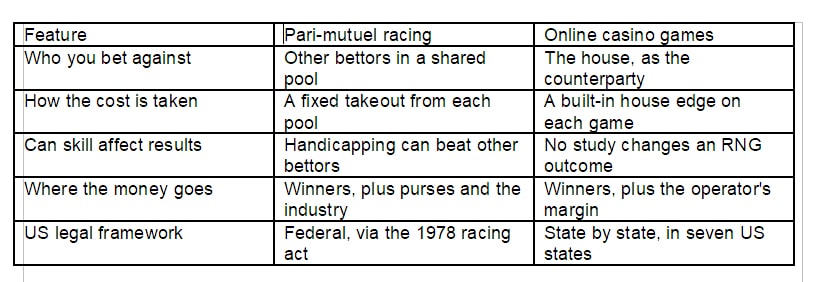
The deepest divide in gambling is not the game. It is who you are betting against. Pari-mutuel racing pools every dollar wagered on a race, removes a set percentage, and divides what remains among the winning tickets. You are betting against the other bettors, and the track is a broker taking a cut, not a rival trying to beat you. Your reward depends on how the crowd bet, which is why a well-judged longshot pays more than a well-backed favorite. The house, in the casino sense, is not in the game at all.
A casino works the opposite way. The house is the counterparty on every hand and every spin, and the odds are built so that, over enough plays, it keeps a slice of everything wagered. That slice is the house edge, and a slot’s return-to-player figure is just the same idea stated from the player’s side. Nobody at the other end is guessing. The math is set in advance and does not move. A racing bettor who understands this one distinction, pool against crowd versus player against house, already understands more about the casino than most people who play in one, because the racing bettor knows exactly where the money comes from and where it goes.
It is worth sitting with that difference, because it changes what winning even means. In a pool, your payout is other people’s money, redistributed by the result and shrunk only by the takeout. Against a house, your payout is the operator’s money, released according to odds the operator chose. The first is a contest of judgment among bettors; the second is a transaction with a business that has priced the deal in its own favor. A horseplayer who wins a photo finish beat the crowd. A slot player who hits a jackpot did not beat anyone. They ran into a payout the machine was always going to make, on average, to somebody, sooner or later.
The Tote Board Was the First Live-Odds Screen
Long before an app refreshed odds in real time, the tote board did it with lightbulbs. Pari-mutuel wagering, invented in the nineteenth century, is a genuinely clever piece of design: it lets a track offer betting on an unpredictable event without ever risking its own money on the result. The takeout, the percentage skimmed from each pool, is fixed and public, and everything left over belongs to the winners. The odds you see are simply the current split of the pool, which is why they keep shifting until the gates open and the money stops.
That structure rewards a real skill. Because you are betting against other people rather than a machine, being better informed than the crowd can genuinely pay, and the concept of pari-mutuel pooling is well documented for anyone who wants the mechanics in full, including its close cousin, advance-deposit wagering, which moved the windows onto phones and computers. Handicapping does not beat a fixed house edge, because there is no fixed house edge to beat. It beats other handicappers, some of the time, by enough to matter to the sharp minority who put in the work. Keep that idea close, because it is exactly the thing that does not carry over to the machines.
The United States Runs the Two on Different Tracks
Here is where the racing world and the casino world stop rhyming. In the United States, horse racing has its own federal lane. The Interstate Horseracing Act of 1978 built a consent-based system for accepting bets across state lines, and that framework is why advance-deposit wagering on races has been legal in much of the country for years, with the host track, the host state, and the bettor’s state all agreeing to the arrangement. Racing, in other words, got a national structure decades ago.
Online casino play never did. It is decided state by state, and the count is small: just seven US states currently run licensed online casino games, all restricting play to adults 21 and older, and each with its own regulator writing its own rules. Pennsylvania is one of them, and the Pennsylvania Gaming Control Board publishes the licensed operators and the terms they answer to. Online sports betting has spread far wider, to roughly thirty-plus states, but casino gaming, the slots and table games, has not, and the two should never be lumped together. A racing reader used to a single federal racing framework may find the patchwork surprising: there is no national online casino in the United States, only a handful of separate markets with hard borders drawn by geolocation.
What Racing’s Integrity Fight Can Teach a Young Industry
Racing has spent recent years rebuilding trust the hard way. The Horseracing Integrity and Safety Authority now sets national, uniform safety and anti-doping rules for Thoroughbred racing in the United States, backed by an enforcement arm that investigates violations. Whatever one thinks of the details, the direction is clear: a betting sport concluded that credibility has to be engineered, not assumed, and that uniform rules beat a scatter of local ones. It is a lesson written in the sport’s own difficult history.
Regulated online casinos are wrestling with a version of the same problem, from the other end. Their integrity questions are about the player and the payment rather than the athlete: identity checks, age verification, geolocation to keep play inside a legal state, anti-money-laundering review, and responsible-gambling tools built into the account. A racing fan who has watched HISA argue that a sport cannot police itself on trust alone will recognize the instinct behind a casino regulator demanding audited random-number generators and verified identities. Both are answers to the same question, which is how a betting business earns the right to be believed. The subjects differ, the horse on one side and the account holder on the other, but the underlying move is identical.
The parallel is instructive for anyone tempted to trust a betting product on vibes. Racing learned, sometimes painfully, that a wink and a handshake do not reassure a modern audience, and that outside enforcement is the price of a clean reputation. A player weighing an online casino should apply the same standard in reverse: an operator that submits to a named regulator, publishes its licenses, and can be complained about is playing a different game than a slick offshore site that answers to nobody. The presence of an integrity structure is not a guarantee of good luck, and it never will be, but it is the difference between a wager placed inside the rules and one placed on faith.
Purses, Takeout, and the House Edge
Follow the money and the two worlds separate again. In racing, the takeout does more than pay the track. A share flows back into purses, the prize money that keeps owners, trainers, grooms, and drivers in business, and in Ontario that support runs into real figures. Industry reporting in 2026 described an additional multimillion-dollar boost to provincial racing, with core standardbred purses funded in the tens of millions, as detailed by Standardbred Canada. The dollar you bet on a race, minus the takeout, is split among winning bettors, and the takeout itself helps sustain the animals and the people who make the sport exist.
A casino’s house edge does something narrower. It is the operator’s margin, the price of the entertainment, and it funds the business rather than a purse or a paddock. Neither model is charity, and both cost the bettor over time, but they are shaped differently, and the shape is worth seeing side by side.
Where a Canadian Racing Reader Actually Stands
None of the US casino markets are reachable from a couch in Canada, and that matters before anyone gets ideas. Geolocation keeps licensed US online casinos inside their states, so a Canadian player is not the audience for them. Canada runs its own systems. Pari-mutuel racing here operates under federal oversight through the Canadian Pari-Mutuel Agency, part of the federal agriculture department, while online casino gaming is a provincial matter. Ontario opened a competitive licensed market in April 2022 with a minimum age of 19, and Alberta followed in July 2026 with a minimum age of 18. The rules a Canadian actually lives under are set at home, not across the border.
There is a quieter contrast in all of this. Canadian racing carries deep heritage, from the King’s Plate, the country’s oldest Thoroughbred race, run since 1860 and renamed at Woodbine in 2023, to the Standardbred racing nights at Woodbine Mohawk Park. A regulated online casino sector, by comparison, is a young thing, measured in a few years rather than a century and a half. A racing reader is entitled to a little perspective here: the newest, flashiest way to bet is not the most tested, and the oldest wager on the card still runs on a logic worth understanding before you try any other.
Skill at the Windows, Chance at the Machine
This is the honest heart of the comparison, and it deserves plain words. The edge a good handicapper builds is an edge over other bettors, earned by knowing more than the crowd about a real event with form, history, and reasons. It is genuine, and it is also narrow, and it belongs entirely to the pari-mutuel pool. Carry that same confidence to a slot machine and it evaporates. There is no crowd to outthink, no form to study, and no counterparty making a mistake you can punish. There is only a fixed edge that applies to every spin, no matter how much you know.
That is not a knock on either activity. It is a boundary line. A racing bettor can be sharp; a slot player cannot be, in the sense that matters, because the game gives skill nothing to work with. A return-to-player figure is a long-run average across enormous numbers of spins, not a hint about the next hour. Anyone who tells a horseplayer that handicapping instincts transfer to the reels is confusing two very different bets, and the confusion tends to be expensive.
A Sport, a Wager, and a Clear Head
For all the structural talk, the practical advice is the same on both sides of the rail. Bet money you have set aside for entertainment, decide the limit before you start rather than during, and stop when the fun does. Regulated markets, in racing and in casino gaming alike, exist partly to make that discipline easier, with tools to set limits and doors marked for help. In Canada, online casino play is for adults, 19 and older in Ontario and 18 and older in Alberta, while US online casinos hold to 21, and free, confidential support is a phone call or a click away for anyone who wants it, including through the US National Council on Problem Gambling.
The racing world’s real gift to this conversation is a clear head about what a bet is. A wager is a price paid for a chance, and the smart bettor always knows which chance is being bought and at what cost. Read the US casino market that way, as a set of licensed but house-favored games walled off inside seven US states, and it holds no mystery. It is simply a different window, with different math, run for a different reason than the one that pays the purses back home. Understand that, and you can look at the whole US casino boom the way a seasoned bettor looks at a crowded tote board: with interest, with a clear sense of the cost, and without mistaking motion for opportunity.
Frequently Asked Questions
How is pari-mutuel racing different from a casino game?
In pari-mutuel racing you bet against other bettors in a shared pool, and the track removes a fixed takeout before dividing the rest among winners. A casino game is house-banked, meaning the operator is your counterparty and keeps a built-in edge over time. The first pits you against the crowd; the second pits you against fixed math.
Is online casino play legal across the United States?
No. Online casino gaming is legal and licensed in only seven US states, each with its own regulator, and all restrict play to adults 21 and older. Online sports betting is far more widespread, in roughly thirty-plus states, but that is a separate category. There is no national online casino in the United States.
Can Canadians use US online casinos?
Not from Canada. Licensed US online casinos use geolocation to keep play inside the specific states where they are legal, so a player physically in Canada cannot access them. Canadians have their own provincial options instead, such as Ontario’s licensed market, which opened in 2022, and Alberta’s, which opened in 2026.
Does handicapping skill help at slot machines?
No. Handicapping can give a real edge over other bettors in a pari-mutuel pool because you are judging a real event. A slot machine has no crowd to outthink and a fixed house edge on every spin, so no amount of study changes the outcome. The skill that works at the windows does not transfer to the reels.
Why does racing have a national US framework when casinos do not?
Horse racing got the Interstate Horseracing Act of 1978, a federal law that set up consent-based betting across state lines and later covered advance-deposit wagering. Online casino gaming was never given a comparable national law, so it developed state by state. That is why racing looks unified across the country while online casinos remain a small patchwork.
The Latest