Betting and horse racing have been tangled together in Canada since long before anyone thought to build a website around either one. The Halifax Turf Club was already holding meetings in 1825, decades after local authorities had briefly tried banning racing altogether over fears it was turning citizens into “idle, immoral gamblers.” Two centuries later, the sport and the wagering around it are still just as tied together — only now the paddock rail has been replaced by a phone screen. You can learn more here about how today’s horse racing betting sites compare.
Why Racing Fans Shop Around More Than Other Bettors
Horse racing bettors tend to compare platforms more aggressively than sports bettors in general, and there’s a structural reason for that. Fixed-odds racing markets vary noticeably between operators depending on which tracks and race cards a given platform prioritizes, unlike a football match where major bookmakers tend to converge on similar numbers. A track like Woodbine drawing a smaller international audience than a Kentucky Derby broadcast means odds on Canadian cards can differ more between platforms than odds on marquee US or UK racing, simply because fewer books are actively pricing the same Canadian race with equal attention.
That pricing gap rewards comparison shopping in a way that’s less true for higher-profile global sports betting markets.
Fixed Odds Versus Pari-Mutuel: The Distinction That Actually Matters
Anyone moving between the track and an online sportsbook needs to understand one structural difference before anything else. Canadian racetracks, including Woodbine, operate on a pari-mutuel system, where all wagers on a race go into a shared pool and payouts are calculated after the house takes its percentage — meaning the exact payout isn’t fixed until the pool closes. Online sportsbooks offering racing markets, by contrast, typically post fixed odds locked in at the moment of the bet, which can work in a bettor’s favour if the odds shorten before post time, or against them if the field narrows late.
Neither system is objectively better, but the difference explains why a bettor might see meaningfully different final payouts for what looks like an identical bet placed through two different channels on the same race.
The Bet Types Specific to Racing Worth Knowing
Racing carries its own vocabulary that doesn’t map onto typical sports betting markets. An each-way bet splits a stake between a horse winning outright and finishing in a placed position, common for larger fields where backing a placing gives more realistic odds of a return. Exotic bets — exactas, trifectas, and superfectas — require picking multiple horses in the correct finishing order, carrying significantly longer odds and higher potential payouts than a straight win bet.
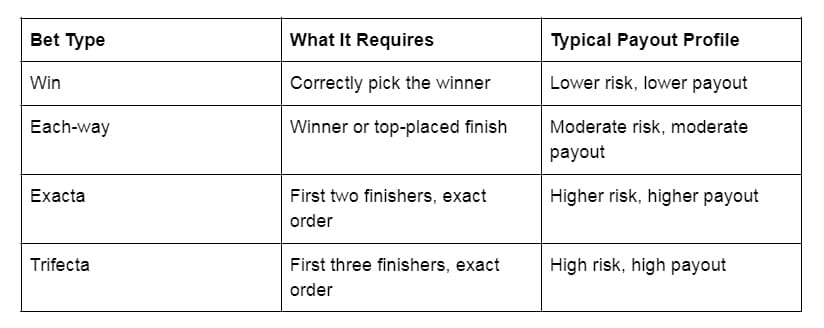
Not every platform offers the full range of exotic bets on every race, particularly for smaller Canadian cards, which is another reason serious racing bettors tend to maintain accounts across more than one operator rather than settling on a single default.
How to Actually Compare Racing Odds Before Betting
1. Check whether the platform prices the specific track and race card you’re interested in — not every operator covers every Canadian meet with the same depth.
2. Compare the odds on the specific horse you’re backing across two or three platforms rather than assuming general reputation translates to the best number on every race.
3. Confirm whether the platform runs fixed odds or pari-mutuel pools for that particular race, since the two aren’t directly comparable in the way they behave as post time approaches.
4. Look specifically at exotic bet availability if that’s your preferred format, since coverage varies more for exactas and trifectas than for straight win bets.
None of these steps take long, but skipping them is exactly how a bettor ends up settling for a worse number out of habit rather than comparison.
Where Racing Fandom and Ownership Overlap With Betting Interest
A meaningful share of racing’s betting audience isn’t purely recreational — plenty of fans following the sport closely also have some stake in ownership, whether that’s a full horse, a partnership share, or simply a long-standing interest in a specific stable’s form. For readers considering that step themselves, what’s actually involved in owning a Thoroughbred racehorse covers the practical side of ownership options, from sole ownership to shared partnerships, alongside the licensing and registration requirements that come with it in Ontario specifically.
That overlap between ownership interest and betting interest isn’t incidental. Fans who follow a specific stable, jockey, or bloodline tend to bet with more conviction on races involving horses they already have a rooting interest in, which is part of why racing retains a more engaged, detail-oriented betting culture than markets where the bettor has no connection to the competitors beyond the odds themselves.
The Bigger Picture for Canadian Racing Fans
None of this changes the fundamentals that have applied since the Halifax Turf Club’s first meetings two centuries ago: understand the specific market you’re betting into, know what you’re actually being paid for a given outcome, and treat comparison as part of the process rather than an afterthought. What’s changed is simply the tools available for that comparison — moving from a trackside board to a handful of browser tabs hasn’t altered the underlying logic of the bet itself, only how quickly and thoroughly a fan can check whether they’re getting a fair number before committing.
The Latest