Two things happened in Canadian gambling this July, twelve days apart, and only one of them got much attention outside the racing business. On July 1, the Canadian Pari-Mutuel Agency’s amended payments order came into force, lifting the federal levy on Canadian pari-mutuel betting from 0.8 percent to 1 percent of every dollar wagered. On July 13, Alberta became the second province after Ontario to open online casino and sports betting to private operators, with around 50 companies reported to have completed registration with Alberta Gaming, Liquor and Cannabis and more than 20 sites reported live on the first day.
The racing industry noticed the first date. The general public noticed the second one. Anyone who breeds, trains, owns, grooms or simply follows horses in Alberta has reason to pay attention to both, because they describe the same underlying pressure from opposite ends: the money that funds racing comes out of a wagering pool that has been shrinking for decades, and that pool now sits in a market with a great many more places for a person’s entertainment dollar to go.
Some precision about what actually opened is useful here, because the coverage has been loose. These are not racebooks. They are house-banked casino and sportsbook products, and the guides that track them, like Lineups’ rundown of draftkings casino alberta, are describing something structurally different from what happens when you bet a horse. Not a competitor to the tote in any technical sense. A competitor for attention and disposable income, which in practice matters more.
Two systems that only look alike from the outside
To someone who has never bet either, a slot machine and a win ticket look like variations on a theme. They are not. They are built on opposite mathematics, and the difference is the whole story.
Pari-mutuel betting is a pool. Everyone backing a race puts money into a common pot for each wager type. The track and the associated bodies remove a fixed percentage off the top, called the takeout. Whatever remains is divided among the holders of winning tickets. That is where the odds on the board come from. They are not a price offered by an operator; they are a live readout of how the money in the pool is distributed at that moment, which is why they drift right up to post time and why the payout you actually receive is set after the pool closes, not when you bought the ticket.
The consequence is that in pari-mutuel wagering you are betting against the other bettors. The track is not on the other side of your wager and does not care which horse wins. It takes its takeout either way. Skill is genuinely relevant here, because you are competing against other people’s opinions rather than against a fixed mathematical edge, and the crowd is fallible in ways that reward homework.
House-banked casino games work the other way. The operator is your counterparty. Every game has an edge baked into the rules and paytable, expressed as a return-to-player figure that describes long-run average behavior across an enormous number of outcomes, not what any individual session will do. Slot results are pure chance. Nothing you learn about a game changes its distribution. That edge is not a flaw or a scandal, it is simply the product being sold, and it is the reason the operator can afford to be open at four in the morning with nobody else in the room.
The comparison in plain terms
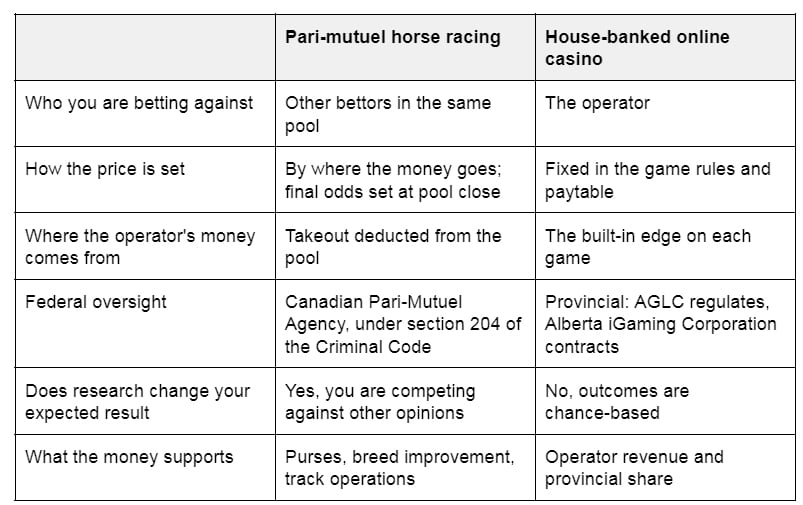
That bottom row is the one the racing industry should sit with. A dollar wagered through the tote circulates back through the sport. It contributes to the purse account, which pays the people who own, train and ride the horses. A dollar wagered on an online blackjack table does not. It is a perfectly legitimate dollar and the province will collect its share of it, but it does not put hay in front of anything.
Alberta racing already lives downstream of gambling money
This is the part that makes Alberta a distinctive case rather than a generic one. Racing here is not funded purely by handle. It is funded substantially by slot machines.
Horse Racing Alberta’s arrangement with the province has for years directed a share of net revenue from slot machines at the Racing Entertainment Centres attached to Alberta tracks into the racing industry. Reporting on the renewed agreement described the industry’s share stepping down from roughly 51.67 percent of that revenue toward 40 percent over a three-year phase-in, with the remainder split between the centre operators and the province. Horse Racing Alberta’s own reporting in recent years has put purses in the neighborhood of 14.9 million dollars with breed improvement funding of about 4.3 million, figures that moved up rather than down.
So Alberta racing’s purse structure is already tied to casino-style gambling. It has been for two decades. That is not a scandal, it is a deliberate policy trade that many jurisdictions made, and it has kept racing viable in a province where the pari-mutuel handle alone could not carry it.
Which raises the obvious question about July 13. Those slot machines sit inside physical buildings. The new market is a phone in every pocket, at all hours, with no drive to Balzac or Nisku involved. If a share of that play migrates from the machine at the Racing Entertainment Centre to an app, the revenue base that funds Alberta purses is affected in a way that has nothing to do with how many people are betting horses.
Nobody can responsibly put a number on that yet. The market is days old. Handle and slot figures for the period will not be meaningful for a good while, and anyone claiming to know the split already is guessing. But the mechanism is not speculative, and it is the right thing for the industry’s boards and horsemen’s associations to be modeling now rather than after the fact.
Handle was already the harder problem
The migration question lands on top of a longer trend. Total pari-mutuel wagering in Canada has been in slow decline for decades. The federal levy that funds the Canadian Pari-Mutuel Agency is charged against that handle, and the agency’s decision to raise it from 0.8 to 1 percent this July is a fairly direct signal of what happens when a fixed cost base sits on a shrinking revenue line. When the base gets smaller, the rate has to move to hold the same dollars.
Single-event sports betting became legal federally in August 2021 under Bill C-218, and Ontario’s private-operator market opened in April 2022. Analysis of the Canadian handle since then has been genuinely mixed rather than catastrophic, with one fiscal year coming in above expectation near pre-pandemic levels and later periods running below. The honest reading is that the effect exists, is hard to isolate from demographic decline and race-day supply, and has not produced the collapse some predicted.
Alberta is now a second natural experiment, and a cleaner one in some respects, because the province’s racing sector has a funding link to gaming revenue that Ontario’s does not share in the same form.
The thing that does not transfer
There is a temptation in articles like this to tell the racing reader that their skills give them an advantage in the new market. They do not, and saying so would be a disservice.
Handicapping is real analytical work. Reading past performances, understanding pace scenarios, judging how a horse handles a surface or a class rise, spotting when the board has overvalued a name and undervalued a form cycle: those are skills, and they pay off precisely because pari-mutuel betting sets you against other people who may be doing that work badly. Sharp handicappers exist for the same reason sharp poker players exist. The counterparty is human.
None of that applies to a slot reel or a roulette wheel. There is no form to read, no crowd to be smarter than, no pace scenario. The distribution is fixed and the edge belongs to the house on every spin regardless of who is spinning. A person who can read a Beyer figure has no advantage whatsoever at a casino game, and the belief that they do is exactly how people who consider themselves disciplined bettors get into trouble.
The honest framing is a contrast, not a bridge. One of these is a skill game with a takeout. The other is entertainment with a price. They are both legal in Alberta for adults 18 and over, they are regulated by different authorities under different legal instruments, and treating them as the same activity is a mistake in either direction.
What the racing side can actually do about it
Complaining about competition for the entertainment dollar has never moved a handle figure. A few things might.
The first is arguing the fixed-odds question seriously. Fixed-odds wagering on horse racing is not permitted in Canada, where the pooled system holds the field, though it operates in other racing jurisdictions and has been discussed here for years. There are real arguments on both sides, including whether it would cannibalize the pools that fund purses. But the argument is now happening in a province where a fixed-odds product on every other sport is available on a phone, which changes the practical case for how racing is presented to a younger bettor who has never seen a tote board.
The second is ownership pipeline. Racing’s most durable revenue is people invested in the sport rather than passing through it, and the economics of getting in are less forbidding than the outside assumes once partnerships, syndicates and leasing arrangements are on the table. Horse Canada’s guide to what you need to know to own a Thoroughbred racehorse lays out those structures and the real annual costs, and that kind of literacy does more for long-term handle than any single promotion.
The third is not conceding the explanation. Racing’s regulatory story is genuinely interesting and almost nobody outside the business knows it. The Canadian Pari-Mutuel Agency has supervised betting on Canadian racing for decades under a federal framework that the agency’s own regulatory framework overview traces back to section 204 of the Criminal Code, with test laboratories, officers at the tracks and requirement documents attached to licences. Very few forms of gambling in this country can point to that history. It is a credibility asset and the sport tends to leave it on the shelf.
Where this settles
Alberta racing is not being displaced by the July 13 launch. It is being asked, more sharply than before, to justify its place in a much wider field of legal options.
The structural contrast is the sport’s best argument, if it is made honestly. Pari-mutuel wagering is the one widely available form of Canadian gambling where informed effort has a genuine effect on results, where the operator is not on the other side of the ticket, and where the money circulates back to an industry of horses and the people who care for them. That is a real distinction. It just has to be stated plainly rather than assumed, in front of an audience that now has twenty other apps competing for the same twenty dollars.
Frequently asked questions
Is pari-mutuel horse race betting affected by Alberta’s new online casino rules?
No. Pari-mutuel wagering on horse racing remains supervised federally by the Canadian Pari-Mutuel Agency under Agriculture and Agri-Food Canada, and that framework was not changed by the province’s iGaming legislation. Alberta’s new market covers online casino and sports betting products regulated provincially by AGLC. The two run on separate legal tracks.
Why did the federal levy on horse racing bets go up this July?
The Canadian Pari-Mutuel Agency is funded by a levy charged against Canadian pari-mutuel handle, and an amendment to the Pari-Mutuel Payments Order raising it from 0.8 percent to 1 percent came into force on July 1, 2026. The agency has fixed supervision costs, so a long-term decline in total wagering puts upward pressure on the rate needed to cover them.
Does the new market take money directly out of Alberta purses?
Not directly, but there is an indirect path worth watching. A share of net slot revenue from the Racing Entertainment Centres at Alberta tracks flows to Horse Racing Alberta and into purses and breed improvement. If some of that in-person play shifts to online platforms, the revenue base behind those payments is affected even if the pari-mutuel handle holds steady.
Can handicapping skill help someone at an online casino game?
No, and it is important to be clear about that. Handicapping works in pari-mutuel betting because you are competing against other bettors’ opinions. Casino games are house-banked with a fixed mathematical edge and chance-based outcomes, so no amount of research or discipline changes the expected result on a slot spin or a roulette number.
What is the legal age for each in Alberta?
Alberta’s legal gambling age is 18, which applies both to pari-mutuel wagering at provincial racetracks and to the newly regulated online casino and sports betting sites. This differs from Ontario, where the online market is restricted to those 19 and over, so age rules do not carry across provincial lines.
The Latest